I should preface this post with a slight disclaimer regarding the various tools included in the discussion below: These are my own opinions, and I am not affiliated in any manner with Literature & Latte nor Microsoft. I’m sure my wallet wishes otherwise, but that’s a story for another day.
One question many authors face from their readers lies in the form of ‘how do you go from thinking of something to converting it into a finished book?’ It’s a seemingly straightforward question, but the answer is another matter. True, every writer will have a somewhat different routine when it comes to producing work, but I think the overwhelming majority would agree there are many steps involved.
The first thing I do, and feel free to call me ‘old-fashioned’ if you like, is to choose which of my favourite pens will be used to storyboard. It was only upon completing my second full piece of fiction that I realised this decision, alongside other small rituals of a similar nature, had carried over from my first foray into writing. I now embrace such idiosyncrasy as part of my life as an author.
This initial selection has firmly cemented itself as part of the foundation for any future projects. It’s as though selecting my implement of choice signifies the very first step on the path ahead. The pen is mightier than the . . . tablet, or something like that.
With ballpoint in hand, I begin to plan the world setting and character profiles for the respective story. As to precisely how I conjure up such environments and imaginary people is more difficult to explain; the basic structures likely come from a lifetime spent reading, while the nuances and unique quirks often develop of their own accord. This is the point I’ve always found most difficult to put into words, the notion of your characters taking on lives of their own during the writing process.
It often feels like something fellow writers instinctively understand, whereas members of my readership find it an impossibility, given the story ultimately unfolds from within my mind. If I wrote them, how could the characters possibly shift without my influence?
Obviously, they don’t. Indeed, everything stems from the thoughts of the writer. However, as dialogues and scenarios unfold you will often find those initial characters who you drew up in such minute detail have changed into entirely different people due to their interplay with the surrounding environment.

An anecdote I sometimes use to explain the ‘organic’ development of such fictional individuals is linked directly back to this initial planning phase. Say, for example, I’ve conjured up a cowboy or bounty hunter using the templates provided – I highly recommend ‘Ready Set Novel!’ by Chris Baty et al., as a superb starting point – and everything from his physical attributes to personality traits have been prepared.
Ok, great. The character is finished, right?
Well, what happens when you’ve written two chapters only to realise, often through being swept up in writing dialogue, the original mannerisms and intended personality of this gunslinger have shifted away considerably from the original intent? However, as a whole the dialogue works and comes across as natural. Do you scrap the entire conversation and start from scratch? Or, do you decide to move forward and edit the character profile retroactively as new ideas take hold?
My rough, taciturn and abrasive rustler has somehow permutated into an affable and loveable rogue with a soft spot for cognac. How did this happen?
There’s no right answer to the above conundrum. I’d argue, so long as the story pans out to your approval it’s valid to adopt either approach. If you’re writing non-fiction things will naturally be very different, as accuracy concerning contemporary or historical figures will be of the utmost importance.
Much the same could be said about world-building. Sometimes you might decide to move a coastal town inland or alter the terrain as the narrative takes shape, in order to facilitate certain plot points or the characters’ movements. Once again, the Earth is rather more set in stone for our beloved biographers, cartographers or journalists.
The main thing is to enjoy the feeling of putting pen to paper as you begin the journey, with a degree of flexibility kept in mind going forward. You see that nice, clean workbook on your desk? Ravage it.
Write and doodle in the margins. Cross ideas out if they never seem to click. Brainstorm across entire pages and list so many bullet points you’ll wonder if there’s enough space left for character profiles. Love the method behind the madness.
As you can no doubt tell, I fall somewhere between the ‘planner’ and ‘pantser’ approaches. The former is pretty much exactly as it sounds, someone who takes great care to develop their setting prior to beginning the actual writing. The latter refers to an author who ‘flies by the seat of their pants’ and is happy to just hit the keyboard without a moment’s hesitation. Most of us fall into the ‘plantser’ column as a balance between both sides, myself included.
I’m happy to plan until the cows come home using various templates and my Kindle Scribe, but when the time comes to write I try to remain open to new concepts or notions when they strike. Things happen, and sometimes it’s best to just go with the flow.
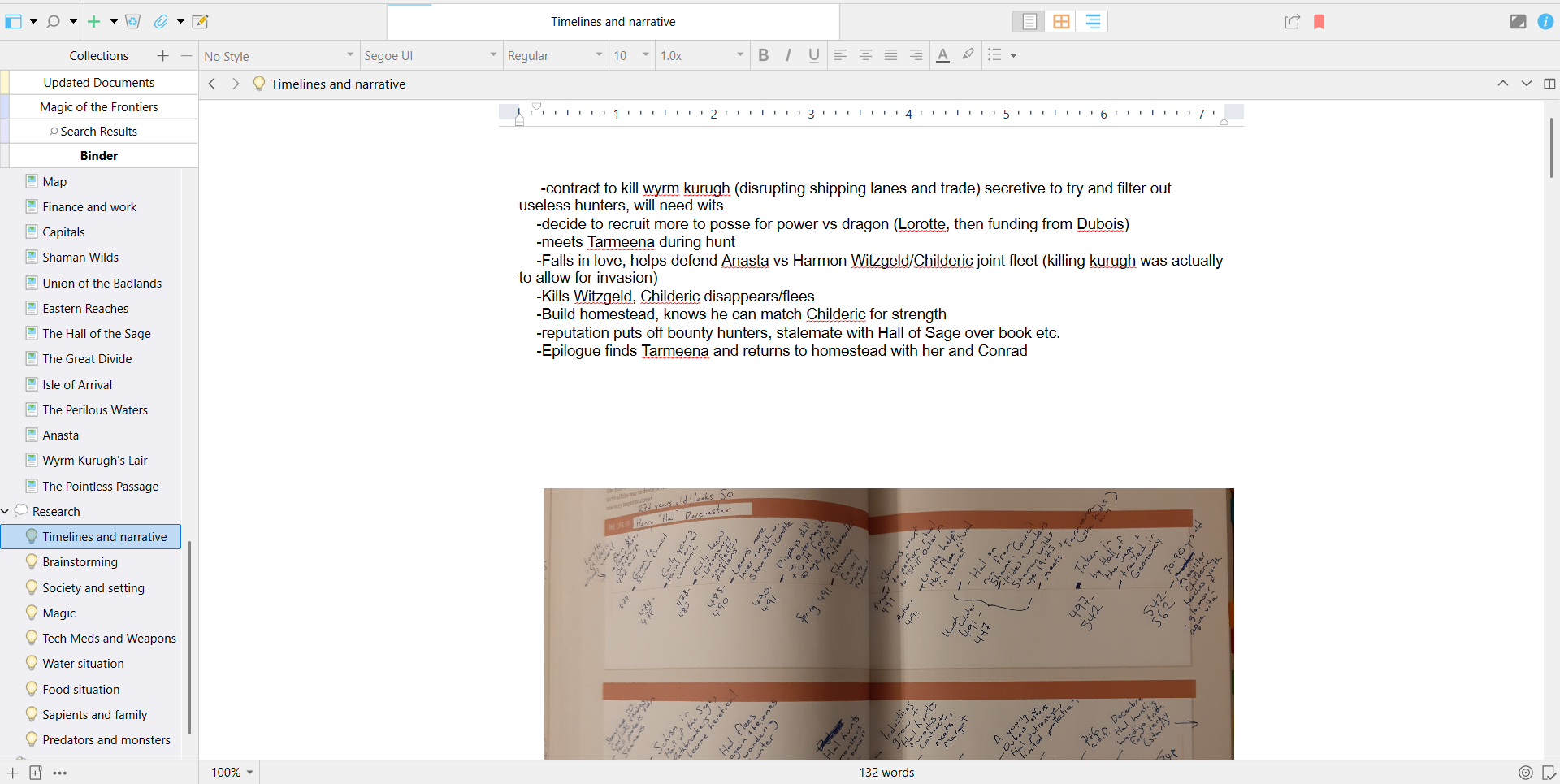
Nonetheless, after feeling content with the initial plans, I next scan all of my documents into the research tab as entries within Scrivener. This ends up being a major time-saver, as I can just scroll down to the entries rather than constantly flipping between the software and physical booklets or notepads. Scrivener is full of such useful tools, ranging from resource tabs, environment planners and a full suite of features you can customise to your own liking.
My typical structure is to have the front matter and body of work followed by the various categories of reference materials below in organised tabs. Scrivener has a bit of a learning curve for new users, but once you have taken the time to master its functionality the experience is arguably the best one out there. Microsoft Word has largely been relegated to last-minute editing of documents prior to their upload if .docx is the required format.
Once everything is copied over and arranged to my approval, I ensure the font set, indents and margins are correct. Then, after having completed the title page and other required front matter such as copyright and dedication, it’s finally time to begin weaving everything together into a coherent story. This is the point where you pour every spark of creativity into the tale.
Writing is an ongoing and never-ending attempt to hone your craft. There’s a very good chance you will look back upon the first draft with a measure of annoyance as your skills continue to grow with subsequent experience.
Sorry, did I say there was a chance? What I meant was you will definitely end up revising chapters and earlier work. Such is the nature of the beast, and it is to be grabbed by the horns. Cherish every little challenge and feeling of accomplishment, no matter how small they may seem.
Finally, once the dust has settled and you’re over the moon about having successfully completed the first draft of your book, it’s on to the next step . . .
Editing.
We don’t speak of editing in this household. Congratulations, you’ve become a writer. Now do it a few dozen more times.
Best wishes,
C.A. Fitzroy
 C.A. Fitzroy
Leave a comment